Tired of information overload?
KRYBL filters the essentials for you. A personalized newsletter, once a week.
Think you need to spend hours every day keeping up with the news? That if you don't read everything, you'll miss something important? That's the trap most people fall into. And it's a myth.
The reality: 10 minutes a day is enough to stay informed quickly and be better up to date than 90% of people -- as long as you use them wisely. Here's how to build your ideal information routine.
Why 10 Minutes Is Enough to Stay Informed Quickly
Your Brain Can't Absorb Everything
Neuroscience is clear: our attention capacity is limited. Gloria Mark, a researcher at UC Irvine, found that our attention span on screens dropped from 150 seconds in 2004 to just 47 seconds in 2020. And the trend isn't improving. After 20 minutes of continuous reading, information retention drops dramatically.
In other words, scrolling for an hour doesn't make you more informed. It makes you more tired -- and opens the door to decision fatigue.
Pareto's Law Applied to Information
The Pareto principle (80/20) applies perfectly to information consumption: 80% of the informational value lies in 20% of the content. Out of 50 articles published in your field today, 2 or 3 actually contain new and useful information. The rest? Recycled takes, commentary, or noise.
The Numbers That Make You Think
- The average American spends 2h20 per day on social media (source: We Are Social, 2025)
- 53% of adults say they feel overwhelmed by the amount of information available (source: Pew Research Center)
- Only 14% of time spent online is dedicated to deep reading (source: Nielsen Norman Group)
The problem isn't lack of time. It's distraction.
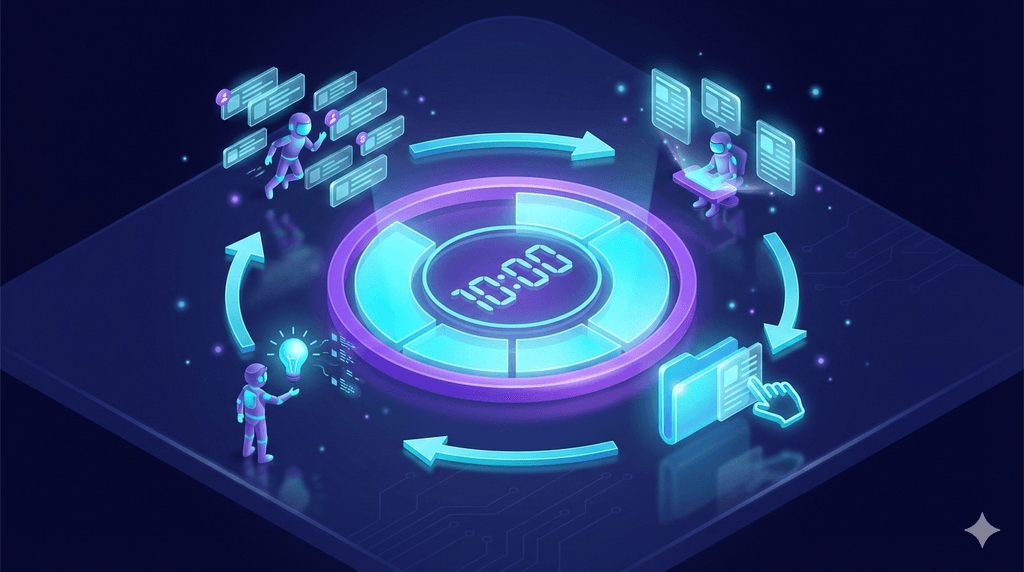
The 4-Step Routine (10 Minutes Flat)
Here's a simple method to apply every morning. Set a timer. You'll be surprised how effective it is.
Step 1: Scan the Headlines (2 min)
Open a single aggregated source -- a curated newsletter, an RSS feed, or your favorite news app. Don't click on anything yet. Just scan the headlines.
Ask yourself one question for each headline: "Does this impact my life, my work, or my decisions today?"
If the answer is no, move on. You'll eliminate 80% of the noise in 120 seconds.
Tip: Avoid sources that use sensationalist headlines. They're designed to grab your attention, not to inform you.
Step 2: Read 2-3 Key Articles (5 min)
From the headlines that passed your filter, pick 2 to 3 articles maximum. Read them with focus. No multitasking. No notifications in the background.
For each article, identify:
- The main fact: what happened?
- The impact: why does it matter to you?
- The action: is there something to do about it?
This active reading transforms passive information into useful knowledge.
Step 3: Save for Later (1 min)
Found a long article that deserves a deep read but doesn't fit in your 10 minutes? Save it, don't read it now.
Use a tool like Pocket, Raindrop.io, or simply a browser bookmark. The idea: never let an interesting article break your routine. Read it on your commute, during lunch, or this weekend.
Step 4: Share One Insight (2 min)
Last step, and the most underrated: share one thing you learned. A Slack message to your team, a tweet, a LinkedIn post, or even a text to a friend.
Why? Because cognitive science research shows that reformulating information significantly strengthens memorization. This is known as the generation effect: actively producing a response anchors knowledge far better than passive reading.
As a bonus, you become the person who shares relevant insights. Not bad for 2 minutes.
Tools to Stay Informed Quickly and Effortlessly
For your routine to stick over time, you need to eliminate friction. Here are the types of tools that help you stay up to date fast. For a detailed comparison, check out our guide on tools to automate your news monitoring.
Aggregators and Curators
Rather than juggling 15 tabs, use a tool that centralizes information:
- Curated newsletters: a human or AI selection of the best articles of the day
- RSS feeds (Feedly, Inoreader): follow your favorite sources in one place
- Targeted alerts: Google Alerts on your key topics
Bookmarking Tools
- Pocket: save and read offline
- Raindrop.io: organize by collections
- Quick notes: Apple Notes, Notion, or whatever tool you already use
The Golden Rule
The best tool is the one you actually use. No need for a complex setup. A personalized newsletter like KRYBL + a bookmarking tool = everything you need.
Mistakes That Sabotage Your Routine
How many of these mistakes are you making without realizing it?
- Starting with social media: algorithms are optimized to keep you scrolling, not to inform you
- Reading without a filter: without selection criteria, you end up reading everything and retaining nothing
- Never unsubscribing: your inbox is probably full of generic newsletters that no longer serve you
- Confusing being busy with being informed: scrolling is not reading
Going Further: Automate the Filtering
10 minutes a day. 4 steps. That's all it takes to stay informed without drowning in the noise.
But there's a way to go even further: let someone else handle step 1 for you. That's exactly what KRYBL does.
KRYBL analyzes thousands of sources every week, filters the noise, and delivers only the information that matches your interests. One personalized newsletter, once a week. From noise to signal.
Your 10 minutes become even more effective when the filtering is already done for you.
Ready to take control of your information time? Try KRYBL free for 15 days and discover what it's like to be truly informed.
Ready to take back control?
Join thousands of readers who chose clarity. A personalized newsletter, to read or listen to, once a week.
Get started with KRYBLRelated articles
5 Tools to Automate Your News Monitoring Effortlessly in 2026
Discover the best tools to automate your news monitoring in 2026: Google Alerts, Feedly, Inoreader, Flipboard and KRYBL compared in detail.
Decision Fatigue: When Too Much Information Kills Good Decisions
Discover why you make poor decisions at the end of the day and how information overload makes it worse. Practical strategies to regain your mental clarity.