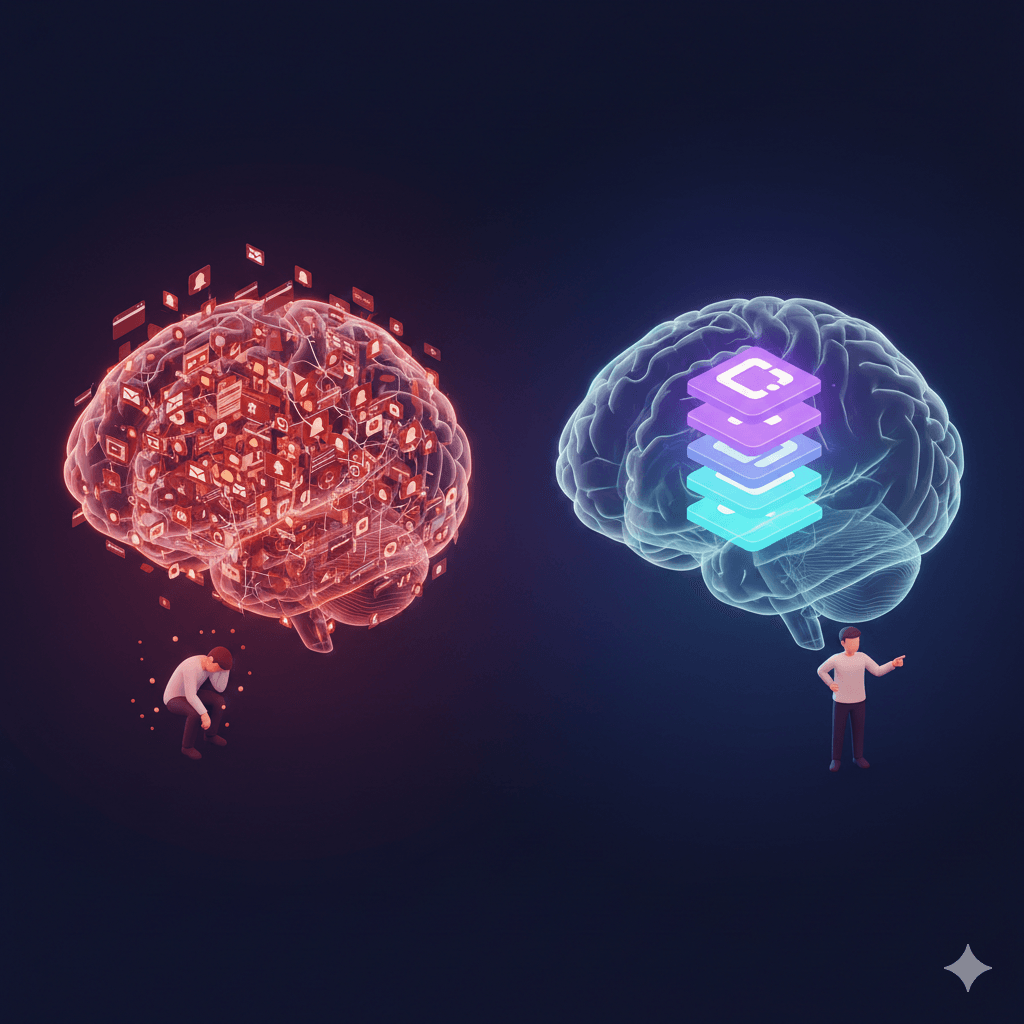
Tired of information overload?
KRYBL filters the essentials for you. A personalized newsletter, once a week.
You've done it before: spent 45 minutes comparing online tools, opened 15 browser tabs, read a dozen contradictory reviews... only to choose nothing at all. Or worse, defaulted to the first option out of sheer exhaustion.
It's not a lack of intelligence or willpower. It's a well-documented psychological phenomenon: decision fatigue.
What Is Decision Fatigue?
Decision fatigue refers to the gradual decline in the quality of our decisions after a long series of choices. The more decisions you make throughout the day, the worse the next ones become.
Baumeister's Landmark Experiment
In 1998, psychologist Roy Baumeister and his colleagues ran a now-famous experiment. Participants had to resist eating chocolate cookies and eat radishes instead. When they were later asked to solve a complex puzzle, those who had resisted the cookies gave up after just 8 minutes on average, compared to 19 minutes for the control group.
The takeaway: our willpower works like a muscle. Every decision, every act of self-control draws from a limited pool of mental energy. Baumeister called this phenomenon ego depletion.
Judges and the Lunch Break
In 2011, a study by Danziger, Levav, and Avnaim-Pesso analyzed over 1,000 parole decisions made by Israeli judges. The findings were striking: the rate of favorable decisions dropped from 65% to nearly 0% over the course of each work session, then jumped back to 65% right after a meal break.
In other words: the time of day your case is reviewed can matter as much as the merits of your case.
Information Overload and Bad Decisions
While decision fatigue naturally builds up throughout the day, information overload acts as an accelerator.
Too Many Choices = No Choice
You may know about Sheena Iyengar's famous jam experiment (2000). In a supermarket, a display offering 24 varieties of jam attracted more browsers, but customers were 10 times more likely to buy when the display offered only 6 options.
The more options we face, the more cognitive resources the brain needs to compare, evaluate, and weigh the pros and cons. The result: we end up choosing nothing at all. This is decision paralysis.
The Cognitive Cost of Constant Information
A 2024 study published in SAGE Journals confirms that information overload in the workplace is directly linked to anxiety, mental fatigue, and elevated stress levels. And recent research on prolonged use of digital tools shows a significant connection with mental exhaustion, attention overload, and a decline in confidence in one's own decisions.
The bottom line: the more information you consume, the less you trust your own judgment.
The Everyday Consequences
Decision fatigue doesn't stay confined to big decisions. It seeps into every part of your life.
Procrastination
When the brain is depleted, it takes the easiest way out: not deciding at all. You postpone decisions, accumulate pending tasks, and push back important projects.
Defaulting
Another strategy of a tired brain: picking the easiest option, not the best one. You keep the subscription you meant to cancel. You accept the first offer without negotiating. You click the first Google result without digging further.
Impulsivity
Paradoxically, decision fatigue can also lead to impulsive choices. When mental resources are drained, the brain abandons rational analysis and follows emotion or immediate desire. That's why supermarkets place candy at the checkout: after 30 minutes of micro-decisions in the aisles, your resistance is at its lowest.
Information Burnout
Over time, accumulated decision fatigue contributes to a state of cognitive burnout. You feel drained at the end of the day, unable to enjoy your free time, irritable when faced with the most mundane choices ("what should we have for dinner?").
5 Strategies to Reduce Decision Fatigue
The good news: you can take action. Here are five evidence-backed approaches to preserve your mental energy.
1. Make Important Decisions in the Morning
Your decision-making capital is at its peak early in the day. Schedule strategic choices (work, finances, projects) for the morning. Save routine decisions for the afternoon.
2. Reduce the Number of Daily Decisions
Steve Jobs always wore the same black turtleneck. Barack Obama only wore blue or gray suits. The idea: eliminate unimportant decisions to save energy for the ones that matter.
In practice: meal prep in advance, build morning routines, automate your news monitoring, and automate everything you can.
3. Limit Your Options
When facing a choice, don't compare 15 alternatives. Pre-select 3 options at most, then choose from those. Apply the "good enough" rule (satisficing) rather than endlessly searching for the perfect choice (maximizing).
4. Take Strategic Breaks
The Israeli judges study proves it: a break restores decision-making capacity. Take regular breaks, especially before an important decision. Have a snack, walk for a few minutes, switch activities.
5. Cut the Information Noise
Every article read, every notification, every social media scroll consumes a share of your decision-making energy. Less useless information = more clarity for real decisions.
Unsubscribe from generic newsletters that no longer serve you. Turn off non-essential notifications. And most importantly, choose one reliable channel that filters information for you.
Less Noise, Better Decisions
Decision fatigue isn't a personal weakness. It's a neurological reality that anyone can learn to manage. One of the most effective keys: reducing the volume of information to process to free up mental space. Building an effective information routine is a great starting point.
That's exactly KRYBL's mission: transforming information chaos into a clear, personalized digest, once a week. No infinite scrolling, no 50 sources to compare. Just the essentials, tailored to your interests.
Conclusion
You can't endlessly increase your capacity to decide. But you can protect the resources you have by eliminating the unnecessary. Less noise, fewer pointless choices, fewer constant solicitations.
Your brain will thank you. And so will your decisions.
Want to cut the information noise and regain your clarity? KRYBL filters thousands of sources to deliver only what matters, personalized to your interests. Try free for 15 days.
Ready to take back control?
Join thousands of readers who chose clarity. A personalized newsletter, to read or listen to, once a week.
Get started with KRYBLRelated articles
5 Tools to Automate Your News Monitoring Effortlessly in 2026
Discover the best tools to automate your news monitoring in 2026: Google Alerts, Feedly, Inoreader, Flipboard and KRYBL compared in detail.
Why Generic Newsletters No Longer Bring You Anything
One-size-fits-all newsletters flood your inbox without truly informing you. Discover why personalization has become essential to stay relevant.